The KOSPI Meltdown
At the beginning of July, I wrote a blog entitled “Is KOSPI a Bad Omen?” and asked the question whether the demolition of the South Korean stock index was going to have implications for US markets. If you don’t recall, the KOSPI is the Korea Composite Stock Index, which tracks all stocks trading on the Korea Stock Exchange. Why is it important? Because the index is heavily weighted towards memory chip and AI-related stocks, SK Hynix and Samsung alone account for more than half of the KOSPI 200. As such, some are looking at the previously obscure index as a harbinger of what could happen in AI-dominated US markets.
When I wrote my last blog on the subject (July 8th), the KOSPI was off 21.6% from its all-time high on June 22nd. Since then, the sell-off continued and bottomed out on July 30th, a whopping 40.9% off the high registered just a little more than a month before. Although the KOSPI has rallied since (it’s up 14.6% since the end of July) and the market is once again showing signs of life, the balloon seems to have been popped—at least for the time being.
Broadly, that’s what happened in South Korea. Does it have broader implications, or was it just a typical market blowoff?
Impending Doom?
Whenever an event occurs that is unexpected or falls into the contrarian AI doom ‘n gloom narrative, the “canary in the coal mine” idiom is invariably brought out of retirement. The KOSPI meltdown, coupled with last week’s well-publicized partial liquidation of a huge AI-themed hedge fund, has led some to declare that both are symptoms of an irrational and overstretched market that is about to correct.
It is important not to overemphasize these events. Yes, both are interesting and newsworthy, but that doesn’t necessarily mean that they are completely applicable to the current situation. First, keep the KOSPI meltdown in context. The South Korean market is a small regional exchange with less than 6% of the S&P’s capitalization, massive retail margin debt, and highly levered ETF participation. It’s also very heavily weighted to AI-related and memory chip issues; Samsung and SK Hynix make up over 50% of the KOSPI 200 and have been as high as 60%. It shouldn’t come as a shock that a market that is highly concentrated and leveraged, dominated by retail, and high on leveraged ETFs will be highly susceptible to vicious sell-offs. That doesn’t necessarily mean that the underlying stocks’ fundamentals are flawed or invalid, just that the market structure and participants were on shaky ground and ripe for a steep sell-off. In other words, the chip trade isn’t over, just the accounts of many investors who got in over their heads.
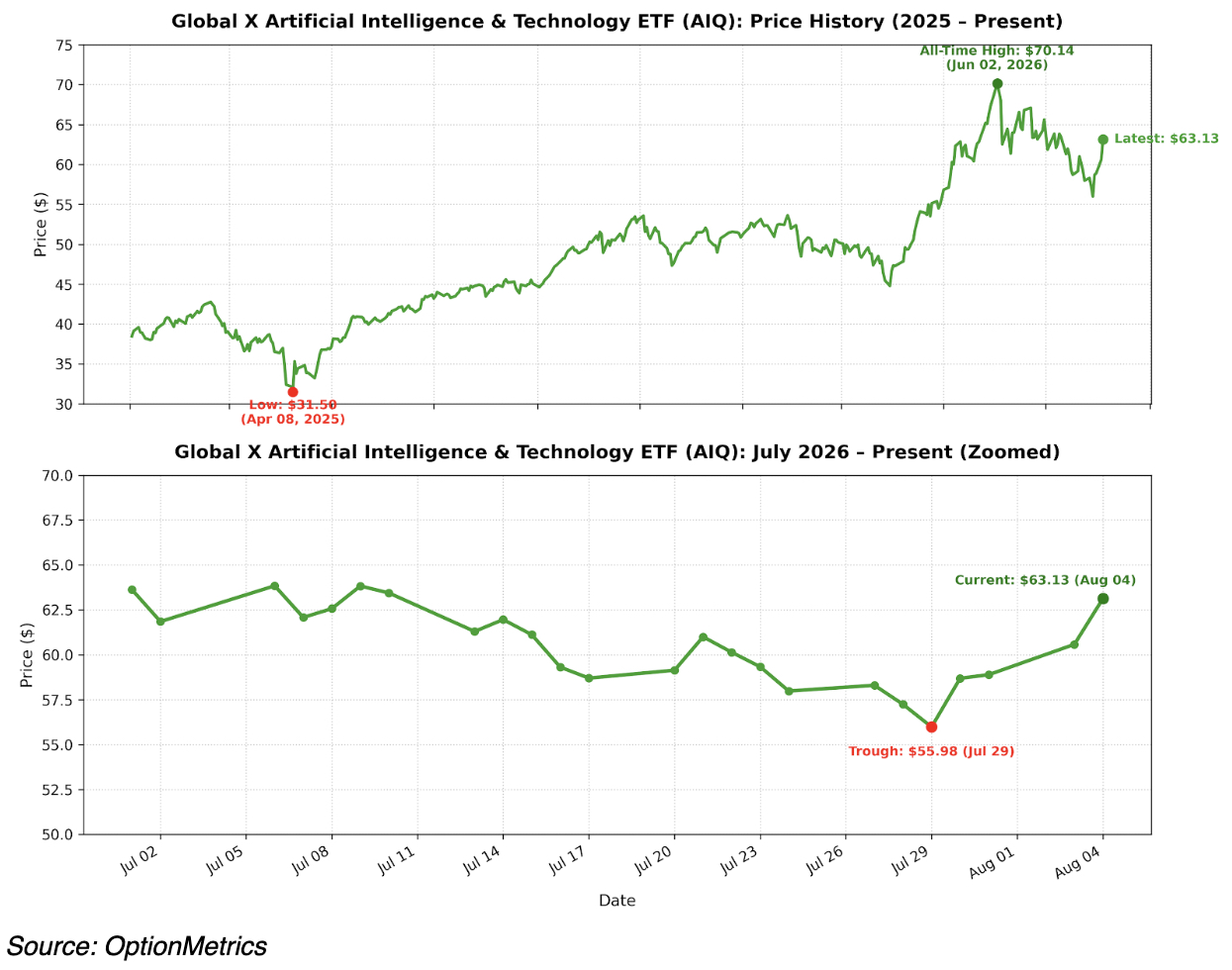
Now that the market has gone through a mini-purge and has been shown the dangers of excessive leverage and concentration (for the millionth time!), it might be time for the AI theme to resume its upward trajectory (see chart below):
In addition, and as an ex-colleague of mine at Bluekurtic (www.bluekurtic.com) points out:
- The last all-time high in the S&P (until today, August 4) was on June 2nd, and stocks have never peaked in June since 1950. Apparently, 2026 is not going to break that pattern.
- A new S&P 500 all-time high today or anytime this month would be the 25th this year, a mark hit only 17 times since 1955 by the end of August. Every single one of those years finished positive, averaging 19.9%. The bull market lives.