Precious Metals. Yesterday’s News?
Remember gold and silver? Early in the year, they were the momentum trade, the latest investment that seemed to perfectly fit the spirit of the times. For over a year, both were consistent winners, reliably making new all-time highs month after month. Like many such trades, the fundamentals supporting them changed over time depending upon what was going on at the time. Central bank purchases, currency debasement, geopolitical unrest, industry demand, ETF flows, economic uncertainty, and general anxiety were all cited as bullish factors at one time or another.
Since gold and silver peaked at $5320.11 and $115.51 respectively (30-day continuous futures), as of last Thursday’s close they have slid 25.0% and 51.4%. To put that into perspective, gold was up 22.9% at its high on 01/29 and silver was up 64.1%. That’s quite a reversal! Their implied volatilities tell a similar story, plunging from their late January highs:
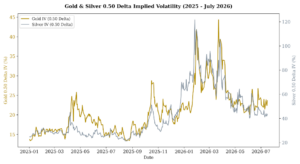
Source: OptionMetrics
And yet, about four months after gold and silver peaked and they began their downward run, some of the factors cited behind the rally are still valid. As a matter of fact, since the peak we’ve had a major war break out in the Mideast, a significant increase in energy prices, and the prospect of much higher inflation. You would think this would be the perfect setup to propel precious metals even higher. So why are they lower?
In previous blogs, I’ve often cited the Economic Policy Uncertainty (EPU) Index. As created by economists Scott R. Baker, Nicholas Bloom, and Steven J. Davis, it quantifies how much doubt exists in the economy by measuring the uncertainty regarding economic policy, federal tax code provisions, and macroeconomic variables. As you can see below, uncertainty has been increasing since about 2008 and reached new all-time records during the pandemic and the new tariff and trade policies introduced in 2025.
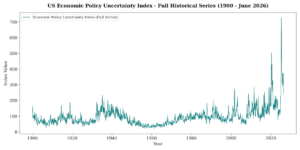
Source: “Measuring Economic Policy Uncertainty” by Scott Baker, Nicholas Bloom and Steven J. Davis at www.PolicyUncertainty.com
In general, precious metals and economic uncertainty are positively correlated, but inconsistently and sometimes with a significant lag. Notice below that the index made new all-time highs in April 2025 during the height of the trade policy panic and about 9 months before precious metals peaked.
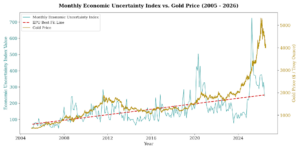
Source: “Measuring Economic Policy Uncertainty” by Scott Baker, Nicholas Bloom and Steven J. Davis at www.PolicyUncertainty.com
Why did precious metals continue to aggressively make new highs? One word: momentum. Retail investors flooded in looking for the Next Big Thing. By then the fundamentals were stale and the market was running on empty. By late-January, exchanges increased margin requirements, provoking a frantic rush for the exits. The balloon had popped.