Is ARKK Back?
Four years ago, I wrote a blog entitled ARK Just Ain’t What It Used to Be (here) about Cathie Wood’s flagship ETF, ARK Innovation (ARKK). At the time, ARKK was the disruptive tech ETF of the pandemic era and a symbol of the stock mania that was sweeping the country. Concentrated in AI, robotics, DNA sequencing, and energy storage, it was in exactly the right place at the right time. In 2020, the fund returned a mind-bending 152.8%, versus 48.6% for QQQ and 18.4% for SPY. By year-end, it was the world’s largest actively managed ETF. With phrases like “disruptive innovation” and “exponential growth trajectories,” Wood quickly became a star among retail investors and a fixture in the financial press and on social media.
Money tends to chase performance and image, and ARKK was no exception. In 2017, the fund averaged about $116 million in assets; by June 2021, it had ballooned to $25.5 billion and ARK was on top of the world. What happened next is a useful reminder that explosive growth can create its own problems.
ARKK’s performance peaked right alongside its assets. When the fund’s concentrated portfolio of high-growth emerging tech stocks fell out of favor in the post-pandemic reset, ARKK lost 23.4% in 2021 and 67% in 2022. Investors headed for the exits, and the fund’s assets dropped to about $6.5 billion.
So, what happened? Rather than concentrating on ARKK’s specific holdings, let’s focus on a few structural forces that can leach performance from almost any fund.
First, it is much easier to manage a smaller fund that no one notices than a giant fund under the glare of constant media attention and numerous copycats. For funds that operate in a narrow universe and hold a relatively small number of stocks, size can create excess concentration and can reduce flexibility. With a relatively small number of holdings, ARKK was simply too large for its niche. That is manageable when markets are rising, but it can become a real problem when liquidity dries up.
It is well-known that performance tends to suffer as funds grow. If that’s true, then why do managers let them grow suboptimally? One word: fees. Fund managers earn money by collecting fees regardless of their performance. That is why many of them seem to be better salespeople than traders. And if they can persuade investors that active management, a strong track record, and unique insight will lead to better returns, they can charge above-average fees (ARKK charges 0.75%). Although high fees may look only marginally higher, compounding makes the cost significant and can turn the relatively minor amount into a serious long-term drag on performance.
Most investors are willing to pay higher fees if they believe performance justifies it. The problem is that the odds are not great. According to the SPIVA (S&P Indices Versus Active) Scorecard, 89.9% of large-cap funds underperformed the S&P 500 over a 15-year period. It doesn’t get much better over shorter stretches: the one-year figure is 78.8%. Small-cap active management looks somewhat better in the short term, with 40.6% of managers underperforming, but reverts to 89.9% after 15 years.
Put all of that together – explosive growth, relatively high fees, and active management — and you get a tough setup for long-term outperformance. Those are headwinds for most funds, and ARKK is no exception.
Still want to trade ARKK? Before you do, it is worth comparing it with a few alternatives, including the Goldman Sachs Future Tech Leaders Equity ETF (GTEK) and, more broadly, QQQ. Here is how the Sharpe ratios stack up since 2021:
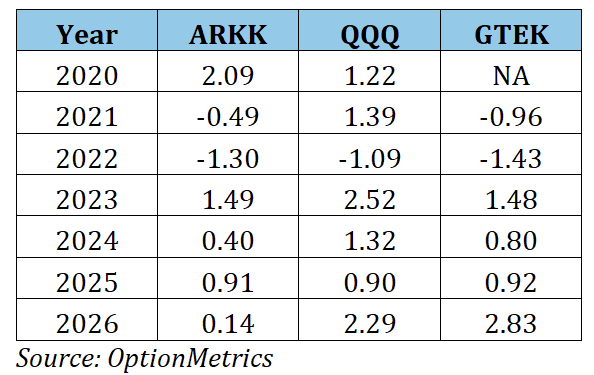
The table tells a pretty clear story: ARKK has struggled to keep up with QQQ and GTEK on a risk-adjusted basis. That fits in with ARKK’s implied volatilty, which at roughly 37.5% trades at a significant premium to QQQ (20.4%) and GTEK (25.5%). ARKK just doesn’t measure up to its competitors.